









When sourcing medical and first-aid supplies, choosing a tourniquet manufacturer requires more than comparing quotations. Distributors, medical supply businesses, first-aid brands, outdoor equipment retailers, and institutional buyers must also consider product specifications, material quality, packaging, customization services, and supply reliability.
For wholesale purchasing, these factors can influence product consistency, inventory planning, and customer satisfaction. Understanding what to check before placing an order can help buyers find a supplier that meets their business requirements and supports long-term cooperation.
What Should Buyers Know About Tourniquets?
A tourniquet is a device used to apply pressure around a limb. Different types serve different purposes, so buyers should distinguish between disposable tourniquets used in certain first-aid or clinical settings and specialized emergency tourniquets designed to control severe limb bleeding.
When sourcing disposable tourniquets, purchasers should first identify the intended application and confirm that the product is suitable for that use. Material composition, dimensions, elasticity, construction, and packaging are important details to review.

For distributors and wholesale buyers, consistent specifications across production batches are also essential. Differences in size, flexibility, appearance, or packaging can affect product handling and the suitability of the product for its intended market.
Why Tourniquet Material and Quality Matter
Material selection is an important consideration when comparing disposable tourniquet suppliers. Thermoplastic elastomer (TPE) is used in flexible products because it offers a combination of elasticity and flexibility.
Contriu's disposable tourniquet is made from TPE and is listed for first-aid, outdoor, and survival applications. The product is blue and supplied in a roll configuration.
For buyers purchasing in bulk, it is worth asking how the manufacturer manages material consistency and production quality. Variations in raw materials or manufacturing processes may affect elasticity, dimensions, surface appearance, and handling characteristics.
Before confirming an order, buyers can request product samples and compare them against the supplier's stated specifications. They should also ask whether the same material and specifications can be maintained for subsequent orders.
Check Product Dimensions and Packaging Before Ordering
Product specifications should be confirmed before buyers make purchasing decisions. Product photographs and general descriptions alone may not provide enough information for wholesale procurement.
According to the listed specifications, Contriu's disposable tourniquet has the following features:
- Material: Thermoplastic elastomer (TPE)
- Color: Blue
- Width: Approximately 1 inch (2.5 cm)
- Length: Approximately 17.7 inches (45 cm)
- Packaging: One roll containing 25 pieces
- Customization: OEM/ODM options are listed
These details help buyers determine whether the product fits their packaging plans, distribution requirements, and intended applications.
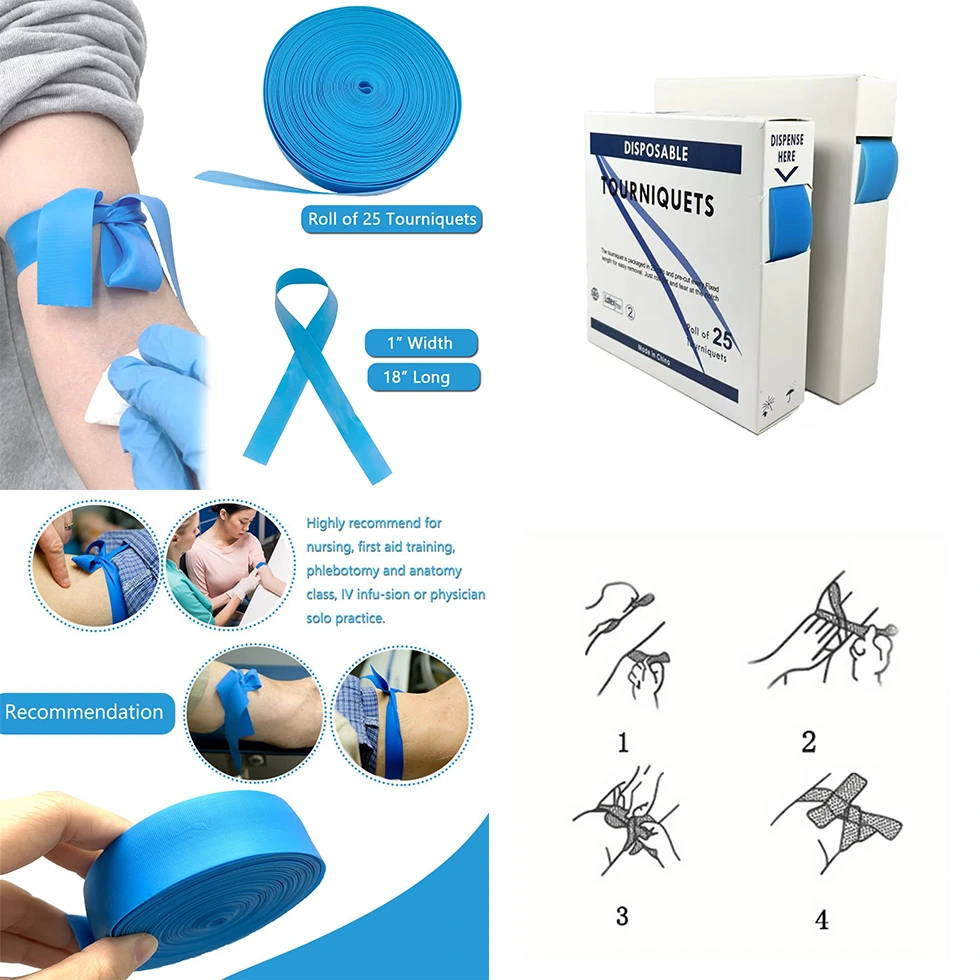
Purchasers should confirm the actual dimensions, quantity per roll, labeling, packaging format, and any available color or specification options directly with the supplier. If products are intended for a particular market, buyers should also check applicable labeling and regulatory requirements before placing a bulk order.
How to Evaluate a Tourniquet Manufacturer
Finding a reliable tourniquet manufacturer involves reviewing several aspects of its business, not simply selecting the lowest quotation.
1. Manufacturing Experience
A supplier with relevant experience in medical or first-aid products may have established procedures for production management and quality control. Buyers should review the manufacturer's product range, manufacturing background, and ability to meet the specifications they require.
2. Production Capacity and Lead Times
For wholesalers and distributors, reliable supply is essential. Before ordering, ask about minimum order quantities, production lead times, available capacity, and arrangements for repeat orders.
These details help businesses plan inventory and reduce the risk of unexpected supply interruptions.
3. Quality Control and Samples
Request samples before committing to a large order. Check the dimensions, flexibility, surface condition, color consistency, packaging, and labeling against the agreed specifications.
It is also useful to ask how the supplier checks incoming materials and finished products, and how it handles products that fail to meet quality requirements.
4. Product Documentation
Documentation is another important part of supplier evaluation. Buyers should confirm which technical specifications, test reports, quality documents, and regulatory records are available.
Any certification or compliance claim should be verified against the exact product and the requirements of the destination market. Documentation for a manufacturer or a different product should not automatically be treated as evidence of compliance for the tourniquet being purchased.
OEM and ODM Services for Custom Tourniquets
Some buyers need products that match their own brand identity or distribution strategy. In these cases, OEM and ODM services may provide additional flexibility.
Depending on the manufacturer's capabilities, customization may cover color, dimensions, packaging, logo printing, labeling, and other product requirements.
Contriu lists OEM/ODM customization with a scale for its disposable tourniquet. Buyers interested in private-label production should confirm the available customization options and whether their specific requirements can be accommodated.
Before beginning a custom order, discuss the minimum order quantity, sample approval process, artwork and packaging requirements, production schedule, and procedures for maintaining specifications across future batches. Confirming these details early can help avoid misunderstandings during production.
Purchasing Mistakes to Avoid
Several common mistakes can complicate wholesale procurement.
Choosing based on price alone. A lower unit price does not necessarily result in lower overall purchasing costs. Product inconsistencies, packaging problems, delays, and repeat-order difficulties can create additional expenses.
Skipping sample evaluation. Samples allow buyers to check whether a product matches their requirements before placing a larger order.
Assuming all tourniquets serve the same purpose. Disposable tourniquets and specialized emergency bleeding-control devices are not interchangeable simply because they share a similar name. Buyers should verify the intended use and product suitability before purchasing.
Overlooking documentation and destination-market requirements. Products intended for medical or first-aid distribution may be subject to specific requirements. Buyers should check the applicable rules rather than relying on broad supplier claims.
Failing to confirm repeat-order consistency. A supplier's ability to maintain agreed specifications and delivery schedules matters just as much as the quality of the initial sample.
Conclusion
Choosing a dependable tourniquet manufacturer and wholesale supplier requires a balanced assessment of material quality, product dimensions, packaging, quality control, production capacity, documentation, customization, and delivery performance.
For buyers sourcing disposable tourniquets, Contriu lists a TPE product intended for first-aid, outdoor, and survival applications. Its stated specifications include a blue design, dimensions of approximately 1 inch by 17.7 inches, packaging of 25 pieces per roll, and OEM/ODM customization options.
Before placing an order, buyers should verify these specifications, request samples, and confirm the documentation and supply arrangements relevant to their intended market. A supplier that can consistently meet agreed requirements is better positioned to support stable inventory planning and long-term business cooperation.
https://www.contriu.com/industry/tourniquet-manufacturer-and-supplier-a-complete-buyer-s-guide.html
Comments (0)