









With today's rapidly advancing technology, camera technology continues to innovate, bringing us unprecedented visual experiences. Shortwave infrared cameras, with their unique imaging capabilities, have demonstrated tremendous potential in numerous fields, becoming a valuable aid in scientific research, industry, security, and more. So, what exactly is so magical about shortwave infrared cameras? How are they changing our understanding of the world? Today, let's delve into the fascinating world of shortwave infrared cameras.
Basic principles
Short-wave infrared usually refers to light with a wavelength of 0.9 to 1.7 μm, which is a longer wavelength than visible light.
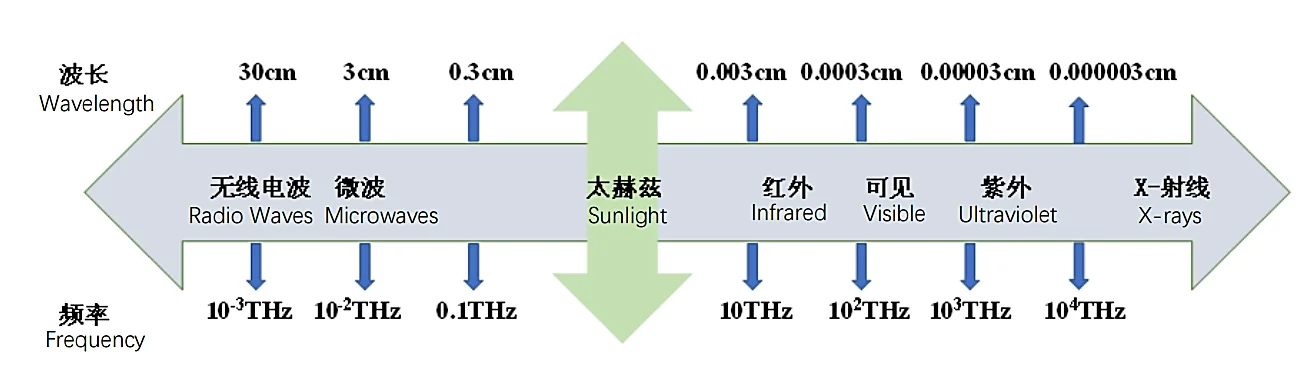
Shortwave infrared (SWIR) cameras use shortwave infrared radiation for imaging. While some material properties of inspected objects are difficult or impossible to observe using visible light, SWIR cameras can still capture clear images. Currently, SWIR cameras are demonstrating significant potential in numerous fields, including industrial inspection, aerospace, and biomedicine.
Key components and functions
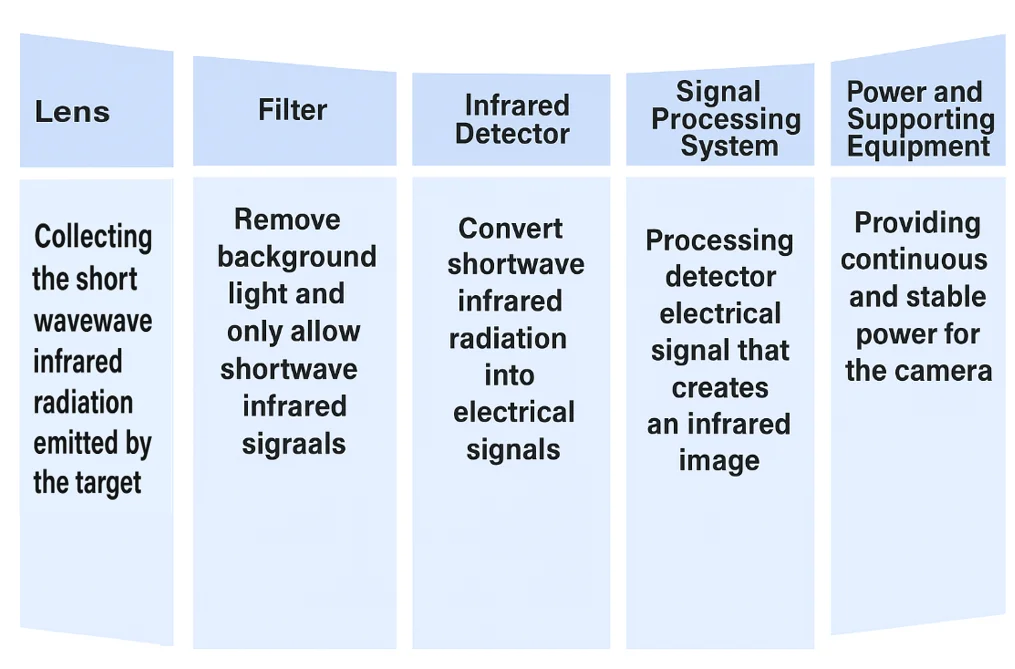
Shortwave infrared cameras are mainly composed of lenses, filters, infrared detectors, signal processing systems, power supplies and auxiliary equipment.
Features and applications
Powerful night vision capabilities
At night or in low-light environments, traditional cameras have difficulty taking clear pictures due to the weak visible light. However, it can capture the weak short-wave infrared radiation emitted or reflected by objects and generate clear images in a completely dark environment. Therefore, it is widely used in military reconnaissance, security monitoring, night patrols and other fields.
Thermal imaging function
Because objects have different temperatures, their short-wave infrared radiation intensities vary. The camera detects this difference and generates a thermal image reflecting the temperature distribution. This is very important in industrial inspection, equipment fault diagnosis, medical diagnosis and other fields. For example, it can detect the heating parts of industrial equipment and assist doctors in diagnosing diseases.
Strong penetration
It can penetrate obstacles such as fog, smoke, and dust. Compared with visible light cameras that are severely affected in harsh environments such as haze and fire, it can obtain clear images and plays an important role in environmental monitoring, search and rescue, firefighting and other fields.
High resolution and high sensitivity
It combines high resolution (clear and delicate imaging) with high sensitivity (capturing weak signals and accurately identifying targets in low-contrast scenes), providing strong support for scenarios such as scientific research and industrial inspection that have extremely high requirements for image quality.
Wide operating temperature range
Wide operating temperature range. Unlike conventional cameras that have strict temperature requirements, it can operate stably in extreme environments such as deserts and polar regions, ensuring image quality and suitable for applications in complex outdoor and extreme conditions.
With their unique imaging capabilities and powerful functionality, shortwave infrared cameras are irreplaceable in numerous fields, including military, industry, scientific research, and daily life. They are profoundly changing the way we perceive and explore the world. As technology continues to advance, the future will bring even more surprises and open up a whole new visual world.
https://www.y-crystaled.net/unveiling-the-superpowers-of-shortwave-infrared-cameras.html
Comments (0)